_alt.png)
Why Shared Artist Studios Have Always Shaped Cities—and Why They Matter Now

Shared artist studios have historically fueled creative innovation by fostering informal collaboration, peer learning, and public visibility—and today, initiatives like Zero Empty (Artist Spaces) continue this legacy by transforming vacant retail spaces into vibrant, accessible hubs for artistic development and urban revitalization.
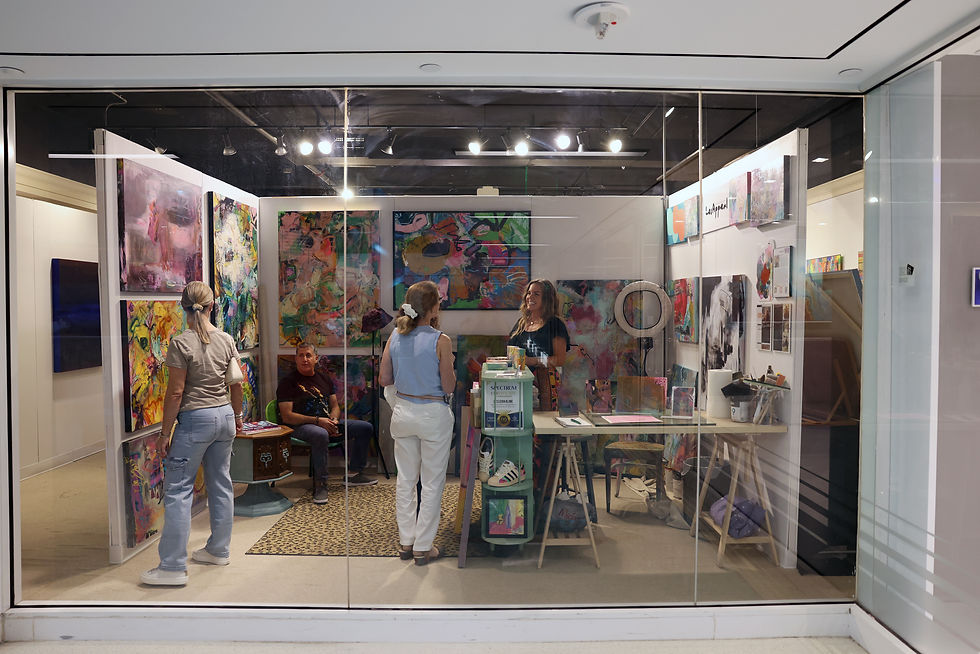
When we examine the long arc of cultural history, periods of artistic vitality rarely emerge from isolation. They arise from shared environments—places where artists work in proximity, observe one another’s processes, exchange ideas informally, and absorb influence through daily exposure. From 19th-century artist colonies to modern studio-based education, the shared studio has proven to be one of the most durable and productive structures for creative development.
Zero Empty (Artist Spaces) sits squarely within this lineage. As one business unit of Zero Empty Spaces—a space activator that converts vacant storefronts into productive uses including artist studios, retail spaces, culinary spaces, and mixology spaces—it represents a contemporary application of a time-tested model. Its contribution is not the invention of communal studio culture, but its repositioning within the commercial landscape, transforming empty retail space into creative infrastructure.
Historical precedents for shared studios.
In the 19th century, artists clustered in villages such as Barbizon or adapted monastic and rural complexes into semi-communal studios. These environments blurred living, learning, and working, offering affordability, proximity to subject matter, and—most critically—constant exposure to peers’ evolving work. Artistic innovation accelerated not through formal instruction, but through observation, conversation, and informal critique embedded in everyday life.
By the early 20th century, groups such as Die Brücke and the Surrealists intensified this dynamic. Shared studios, cafés, and salons became deliberate laboratories for experimentation. Games, manifestos, and collective critiques replaced solitary practice.
In the mid-20th century United States, similar dynamics unfolded in New York’s downtown scene. The artists later known as the Ninth Street Women, including Lee Krasner, Elaine de Kooning, Grace Hartigan, and Joan Mitchell, developed their practices through proximity, shared studios, and constant peer exchange rather than formal institutional support. Working within a tight geographic radius, these artists benefited from daily exposure to one another’s work, critique, and ambition at a time when access to academic and commercial validation remained uneven. Their collective presence did not merely shape individual careers; it altered the trajectory of Abstract Expressionism itself, reinforcing the role of shared creative environments as engines of artistic innovation.
These environments produced more than individual careers; they generated recognizable movements, shared visual languages, and durable networks that extended into exhibitions and markets. Physical co-presence proved catalytic.
The art school studio as modern collective
The rise of the modern art academy formalized what colonies and avant-garde circles had already demonstrated. Atelier systems, Bauhaus workshops, and later university-based art programs institutionalized “studio culture” as a collaborative environment centered on shared workspaces and critique. These recurring rituals functioned much like earlier salons: places where ideas were tested, standards negotiated, and a cohort’s collective identity emerged.
While this model professionalized the shared studio, it also introduced barriers—tuition, admissions, and time-limited access—that increasingly restrict participation. The underlying principle, however, remained unchanged: artists develop faster and work more ambitiously in community.
Zero Empty Artist Spaces in this lineage
Zero Empty (Artist Spaces) can be understood as a decentralized extension of this history, adapted to contemporary economic conditions. As part of Zero Empty Spaces—the broader platform dedicated to activating vacant commercial environments—it addresses two persistent challenges simultaneously: the lack of affordable studio space for artists and the prevalence of empty storefronts in retail corridors.
Over the last six years, Zero Empty (Artist Spaces) has opened 35 locations across multiple states, transforming vacant retail units into working studios offered on flexible, month-to-month terms—often at just a few dollars per square foot, with utilities included. Hundreds of artists have gained professional workspace embedded directly within active commercial districts rather than isolated industrial zones or private homes.
Like historical collectives, these studios intentionally mix emerging, mid-career, and established artists. The result is an intergenerational studio culture where mentoring, technique-sharing, and professional modeling occur informally, woven into daily routines rather than structured programming. What distinguishes this model historically is where it operates: behind glass storefronts, reintroducing artistic labor into public view.
Proven benefits: from individual practice to urban fabric
From a long historical perspective, the benefits of shared studios recur with striking consistency—and they are visible again here.
Accelerated artistic development emerges when learning becomes ambient. In communal environments, every studio visit doubles as instruction. Within Zero Empty (Artist Studios), artists regularly expand their practices by observing neighboring workflows, experimenting with unfamiliar materials, and moving into public-facing formats such as murals and installations that rarely emerge from home studios.
Network formation and visibility follow naturally. Historically, collectives and academies functioned as launchpads into exhibitions and patronage. By situating studios in high-foot-traffic retail environments, Zero Empty (Artist Spaces) extends this logic outward. The public encounters art as an active process, leading to commissions, collaborations, and discovery that occur organically rather than through formal gatekeeping.
Placemaking and economic impact complete the pattern. Artist-led districts have long transformed overlooked neighborhoods into cultural destinations. Zero Empty Spaces’ vacancy-activation model—of which Artist Studios is a core business unit—produces a similar effect: dark storefronts become illuminated workspaces, foot traffic increases, and commercial corridors regain momentum. Local partners consistently credit these studios with strengthening district identity and improving prospects for long-term tenancy.
Across ZES projects, dozens of previously empty units have been returned to daily use, and hundreds of artists have gained professional studios outside their homes—even during periods as challenging as the pandemic. Historically, this sequence is familiar: cultural activation precedes broader revitalization.
A post-academic studio network
If art schools represent the institutional heirs to the atelier, Zero Empty (Artist Spaces) operates as a post-academic studio network. It delivers many of the pedagogical and communal benefits of studio-based education—continuous access, peer learning, critique, and professional rigor—without enrollment, debt, or formal assessment. Studios are accessible around the clock, cohorts evolve organically, and critique arises through conversation, shared events, and open studios rather than academic calendars.
Many participating artists describe entering these cooperative studio environments as “feeling like being back in college,” not because of formal instruction, but because of the immersive creative atmosphere. The shared studios recreate the momentum of an academic setting without the constraints, where artists are surrounded by peers working seriously, consistently, and visibly. Within Zero Empty (Artist Spaces), artists have used the studios to develop new bodies of work, prepare MFA applications, refine portfolios, and test ideas through informal critique and conversation. This kind of sustained, peer-driven development is rarely accessible outside of academia, yet here it emerges organically within a working studio community.
From the perspective of Zero Empty Spaces’ ownership, the significance of this work lies in synthesis. Zero Empty (Artist Spaces) brings together the communality of artist colonies, the critical intensity of studio-based education, and the spatial activism of artist-led placemaking, embedding them directly into spaces once defined by retail decline. It demonstrates that shared artist environments are not nostalgic artifacts or institutional privileges, but scalable, practical tools for cultural vitality—capable of renewing both creative practice and the commercial landscapes in which it unfolds.

Comments